A guide comb can carry a large number that looks like a length, while a smaller label nearby supplies the actual measurement. Read those two things together before describing an attachment. Wahl's Home Haircutting Made Simple booklet gives a particularly clear example: its number 10 is labeled 1¼ inches, about 31 millimeters, and number 12 is labeled 1½ inches, about 38 millimeters. The identifiers are not ten and twelve millimeters. This is a reading exercise using that named booklet's printed pages five and six. It does not establish what a currently sold kit contains, whether an attachment fits a particular clipper or what haircut an individual will achieve. The useful result is a note that preserves an identifier and its stated units without turning them into the same number.
Separate the large identifier from the measurement
The booklet's first guide-comb page shows numbers 1 through 8 with inch and metric labels. For example, number 3 appears beside ⅜ inch and 10 millimeters, while number 4 appears beside ½ inch and 13 millimeters. Those pairs provide a warning against reading the largest printed numeral as though it already had “mm” after it.
Imagine an original equipment note containing only “use 10.” A person receiving that note cannot tell whether it means the comb identified as number 10 or a requested length of ten millimeters. Adding the noun and unit resolves the language problem: “number 10 in this booklet, labeled about 31 mm” says something different from “10 mm.”
The distinction matters even when everybody recognizes the brand. A familiar logo does not put the missing unit back into the message. Keep a photograph or the exact manufacturer's information for the actual attachment with the note, rather than assuming another person's memory supplies the same mapping.
Read the longer pair without inventing a conversion rule
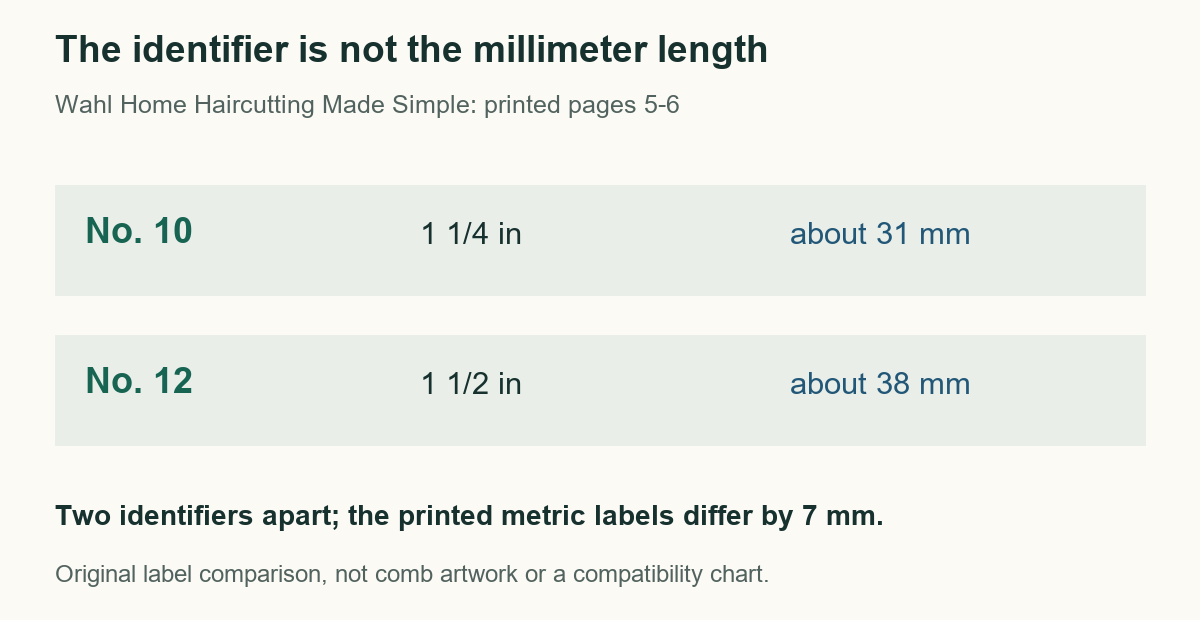
On the following printed page, the larger comb illustrations are explicitly named Number 10 and Number 12. Their accompanying text uses “about” for the inch lengths. Preserve that approximate character when recording the metric labels. The original comparison diagram below presents two labels, not precision measurements of a physical comb.
In our transcription, the first line reads “No. 10 — 1¼ in — about 31 mm.” The second reads “No. 12 — 1½ in — about 38 mm.” The reported metric labels differ by seven millimeters, while the identifiers differ by two. Those are two different subtractions performed on different kinds of numbers.
Do not derive a universal formula from this pair, such as multiplying every comb number by a fixed quantity. The booklet supplies a mapping for the depicted attachments. A numbering convention is useful when its associated scale is known; it is not a measurement system that can be reconstructed from any two convenient examples.
The same restraint applies to the colored combs on the page. The source depicts colors with lengths, but this article does not make a cross-brand color rule or promise that a loose attachment of a similar color belongs to the same family. Read the actual markings and compatible-device documentation before moving from identification to use.
Resolve an ambiguous request before choosing an attachment
Suppose a fictional family member asks for “the ten one” while sorting stored equipment. There are at least two questions to clarify: are they naming the identifier or the millimeter label, and which actual attachment set do they mean? The booklet's two longer combs make the first question concrete, while the equipment's own model information is needed for the second.
A useful reply can stay short: “Do you mean the comb numbered 10 in this guide, or one labeled 10 mm? Please check the actual attachment's label.” That is an original clarification example, not cutting advice. It avoids replacing an uncertain request with a confident choice that could mean something different.
If the marking is unreadable, do not assign an identity by arranging several combs from shortest-looking to longest-looking. Their appearance may help explain what information is missing, but it does not establish the manufacturer's stated length or compatibility. Keep the unresolved piece separate from the clearly identified equipment until the appropriate source can resolve it.
Let the note retain the source it came from
Record the booklet title and printed page with the two fields. A screenshot separated from its heading can easily become a claim about every clipper attachment. Keeping the source identity prevents a genuine manufacturer's example from becoming an unsupported rule for a new purchase.
When considering replacement equipment, request the actual included-attachment and compatibility information for the exact product. The old booklet can explain why the question matters, but it cannot confirm today's contents. The successful outcome here is a clear identifier-and-unit record, ready for that more specific check.
Sources & further reading
Published sources for the details and examples discussed in this story.