
Returning one garment from a promotion does not necessarily mean receiving its full undiscounted ticket price. The useful calculation begins with the price actually allocated to that item after the offer. UNIQLO US explains that coupon deductions are proportional and that a multi-buy discount is prorated across the items in its offer. Follow those two arrangements separately rather than treating every reduced price as the same kind of refund. The baskets below are invented and use amounts that divide cleanly. They are not current offers, real orders or estimates of a particular customer's refund. We first leave tax, shipping and return-label charges outside the merchandise calculation so each number has a visible role, then bring the relevant deductions back into the question.
Basket one: divide a multi-buy price before returning a unit
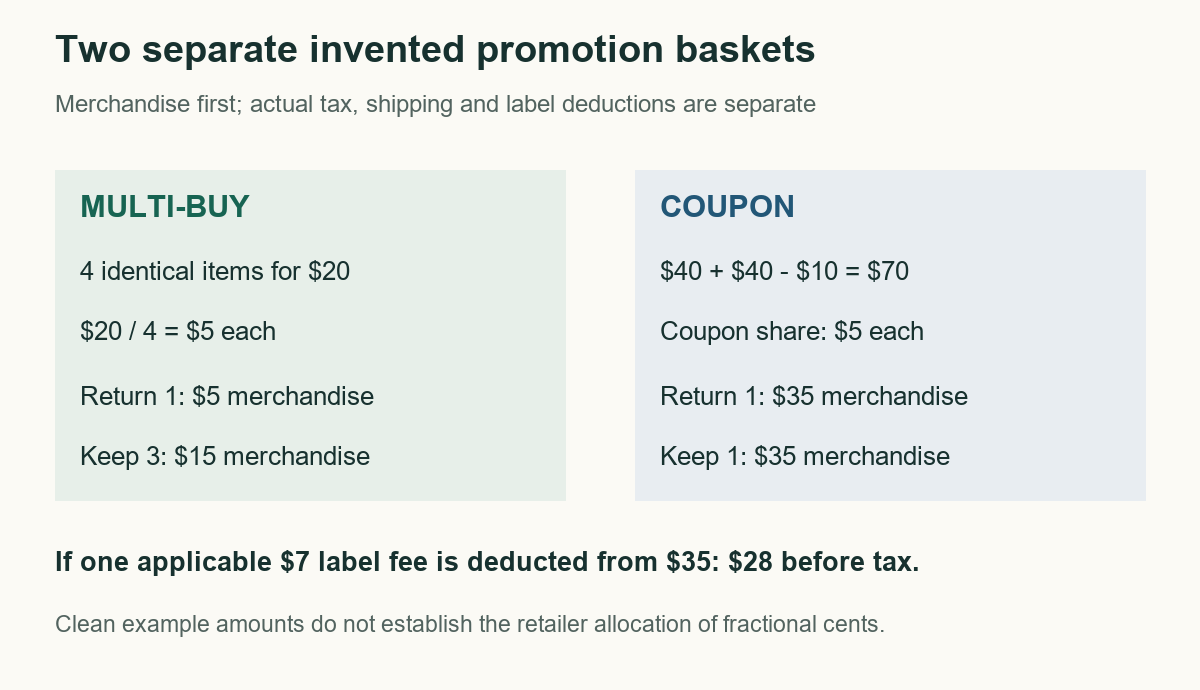
Imagine four identical qualifying garments originally priced at $8 each, bought under an invented four-for-$20 offer. Without the offer, their combined ticket prices would be $32. The actual promotional merchandise total in this example is $20, so an equal allocation gives $5 to each of the four identical items.
Under the prorated multi-buy reading described by UNIQLO's page, returning one of those units has a $5 merchandise amount in our clean example. Three retained units account for $15, and $20 minus $15 leaves the same $5. Those two routes check one another without manufacturing a second discount.
Refunding the original $8 instead would leave only $12 attributed to three retained units, which is not the $5-per-unit allocation we started with. That calculation changes the arrangement rather than merely describing it. The important input is the price basis after the offer, not whichever number is most prominent on an old price card.
The example does not assume a seller cancels the entire offer after a partial return or reprices every retained item at full ticket price. The cited page says the discount is prorated. If an actual offer has additional conditions, retain them with that order rather than importing an imagined threshold rule from another retailer.
Basket two: keep the coupon share with the returned garment
For a separate fictional order, suppose two garments each cost $40 before an eligible $10 coupon. The original merchandise total is $80, the coupon reduces it to $70, and equal item values give each garment a $5 coupon share. Each garment therefore accounts for $35 of the discounted merchandise amount.
Returning one garment does not turn its $5 coupon share into cash. UNIQLO's coupon explanation says the coupon value is non-refundable and the proportional share is deducted from the returned item's value. In this example, $40 minus $5 gives a $35 merchandise refund before other applicable adjustments. The retained garment's allocated amount is also $35, so the two parts still total the original $70 paid for merchandise.
Keep this basket separate from the four-for-$20 one. Combining a coupon and a multi-buy offer would introduce another set of eligibility and calculation questions that these examples have not supplied. A cleaner worksheet is more useful than a complicated order whose discount sequence was guessed.
A brief private note can show three columns: returned item's pre-coupon value, coupon share and resulting merchandise amount. For the fictional garment they read $40, $5 and $35. The column names prevent the coupon from appearing once in the order total and again as an unexplained missing payment.
Merchandise arithmetic is not the final bank credit
The retailer's page also lists a $7 return-label fee, plus applicable tax, per use of a label including a QR code. It says shipping fees are non-refundable and notes applicable tax may be included in refund accounting. Those are separate from our invented merchandise allocations.
If the $35 coupon-example return uses one such label and the stated $7 deduction applies, subtracting it gives $28 before any applicable tax treatment or other actual adjustment. The arithmetic is $35 minus $7, not $40 minus $7. The coupon allocation was already part of establishing the merchandise amount.
That does not establish a final $28 bank credit for every return. Our simplified order excluded tax and shipping inputs, and it supplies no actual return eligibility decision. Use the real receipt and authorized return details to establish which amounts apply. Paying for a garment and having a particular refund approved are different events.
Keep rounding questions visible rather than repairing the source
Clean amounts make the two examples inspectable. They do not solve how a real order allocates fractions of a cent. The retailer's published multi-buy illustration contains rounded displayed figures that do not reconcile exactly when multiplied as printed. Treat that as a reason to obtain the actual order allocation, not permission to silently fix its example and claim the correction is retailer policy.
For a real query, retain the order's item values, applied discount and returned quantity, then ask how the recorded allocation and any deductions produce the refund. A parcel hand-in record establishes a different part of the return story; it does not supply the missing monetary calculation.
Sources & further reading
Published sources for the details and examples discussed in this story.