A color bottle is easier to choose when the rest of its instructions are visible beside it. Sally Hansen's US Insta-Dri and Miracle Gel pages describe different arrangements: Insta-Dri has a built-in base and topcoat, while the Miracle Gel instructions finish the color with a separate Miracle Gel Top Coat. A similar-looking shade name does not make those arrangements interchangeable. This comparison reads the manufacturer's US instructions rather than reporting a wear test. Its practical question is what belongs on the table before beginning: one color product, or a color product and its named finishing product. The small diagrams describe those roles without reproducing the bottles or their packaging.
Separate the bottle count from the coat count
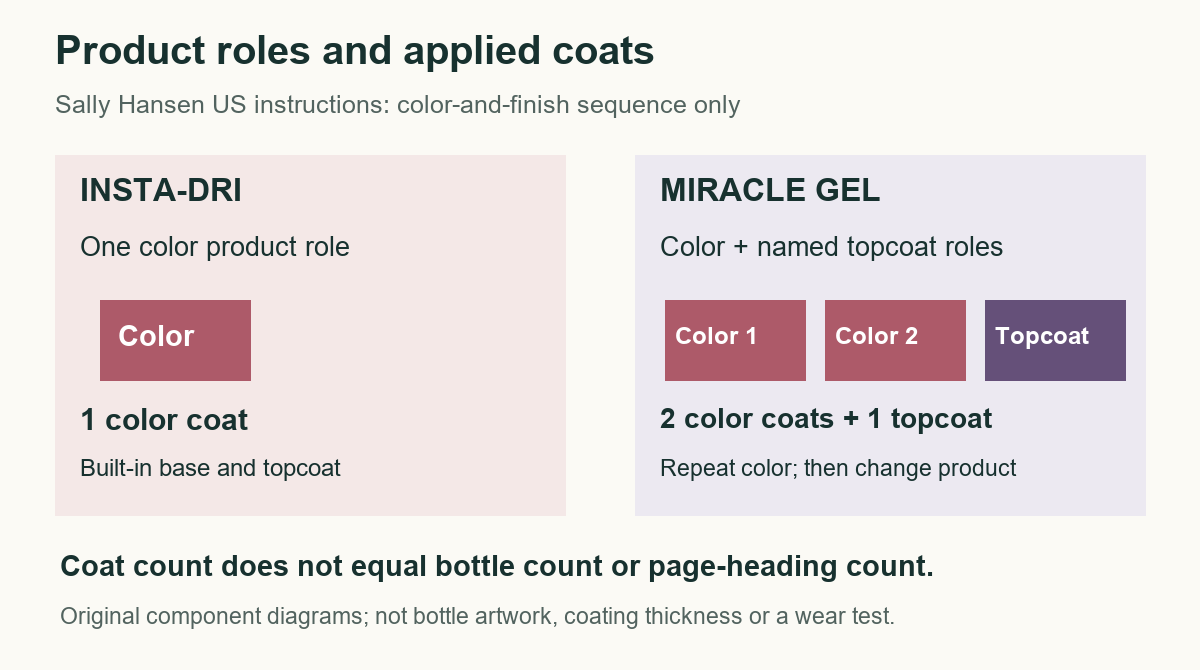
The Insta-Dri page describes a three-in-one formula and directs the user to apply one color coat. Its preparation and drying headings are additional actions, not additional coats from separate bottles. The number of headings on the page therefore cannot be used as a shopping quantity.
For Miracle Gel, the US page directs two coats of color, with each layer drying for five minutes, followed by one coat of Miracle Gel Top Coat. That means two named product roles and three applied coats in the listed color-and-finish sequence. Buying two color bottles would not supply the finishing product just because the color itself is applied twice.
Read the diagrams as a component map. One rectangle represents an application of color; the different finishing rectangle represents the named topcoat. It is a way to keep the sequence understandable, not a drawing of coating thickness or a prediction of the manicure's appearance. The current instructions on the actual product remain important, especially when selecting a different finish or an edition with different directions.
Translate the directions into a short purchase decision
Imagine that you want to replace an empty Insta-Dri color you already use. Under the arrangement described on its US page, the built-in base and topcoat do not create two more product lines to add automatically. First establish that the new item is actually the Insta-Dri color product intended, rather than assuming every item beside the same display has the same role.
Now imagine choosing a Miracle Gel color for the first time. The useful follow-up is whether you also have the Miracle Gel Top Coat called for by that color's directions. An existing bottle labeled “topcoat” is a clue to inspect, not enough information to declare it the named finishing product. The point is to identify the actual item, not to fill an arbitrary two-item basket.
This also makes a gift purchase more precise. “A color and the topcoat named in its directions” describes two different roles. “Two polishes” could describe two colors and leave the recipient without the intended finish. A gift set might already supply both roles, so read its actual contents before buying an extra bottle. This article does not assume that a particular set or promotion includes either item.
A page's steps are not units of product
The word “step” can refer to preparing nails, applying color, waiting or finishing. Those actions are not all purchases. On the current Insta-Dri page, the application appears under its own heading between preparation and drying. Counting all the numbered headings as separate coatings would turn the page into instructions it does not give.
Miracle Gel illustrates the opposite counting problem. One color-application heading contains two coats, and the later finishing heading contains another. A three-heading layout does not mean three bottles. When copying a brief note for yourself, give the action a name instead: preparation, color application, waiting and topcoat application, with the actual coat count recorded where it belongs.
Keep waiting time attached to the relevant action too. The Miracle Gel page's five-minute instruction belongs between its color layers; it is not a price, a number of coats or a promise about how long an entire appointment takes. Preparation, the condition of the actual products and the rest of an individual's routine are separate from a single instruction on a product page.
Read product identity before comparing a tempting color
A shelf display can make color the easiest feature to notice. Put the line name and product role next to that color in your comparison. A note such as “Miracle Gel color; check the named topcoat” is more useful than a shade name alone when you return to a store or ask someone to collect the items.
For an online listing, inspect the selected variant and the stated contents. A photograph containing several bottles may be showing alternatives, a suggested combination or a set. It does not establish which products arrive in the order. Equally, a topcoat selected from a color-family page still needs its exact role checked rather than being treated as another color bottle.
There is no need to turn this into a ranking of the two lines. A person who wants the one-color-product arrangement can recognize what the Insta-Dri description offers. Someone choosing the Miracle Gel arrangement can account for the separate finishing role before paying. Neither decision requires assuming a particular shine, chip resistance or number of days of wear from this comparison.
Keep the useful note with the products
After selecting the actual items, retain their directions where you will use them. A short written sequence can preserve the distinction between a repeated color application and a change of product, but it should not replace missing package information. If a listing and the item received disagree about identity or instructions, resolve that discrepancy with the seller or manufacturer before treating the online example as the product's own directions.
Sources & further reading
Published sources for the details and examples discussed in this story.