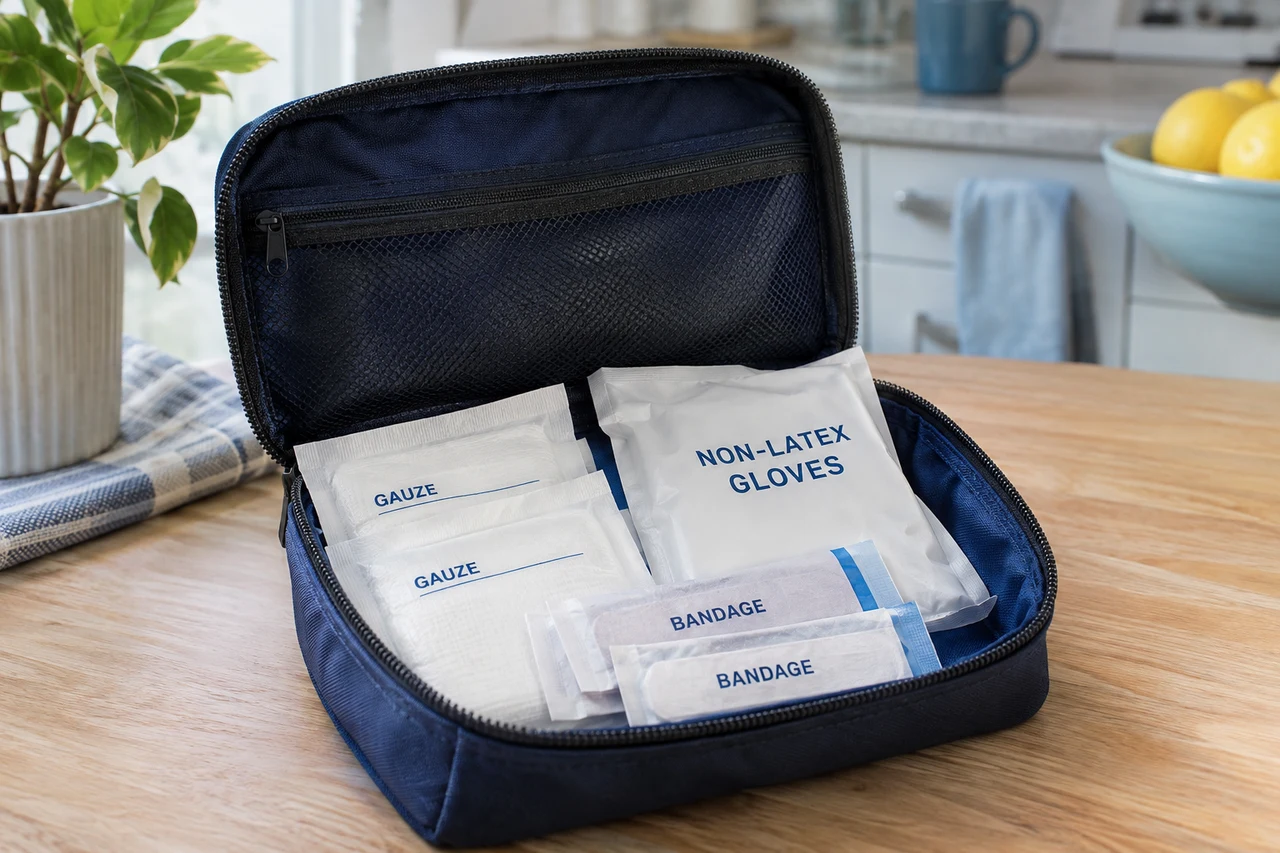
Putting a first-aid case away does not replace the contents removed from it. A small count after use can identify a practical gap before another occasion makes the missing item inconvenient. The American Red Cross advises checking kits regularly and replacing used or out-of-date contents. This example concerns replenishing non-drug supplies, not diagnosing an injury, choosing treatment or declaring a kit medically sufficient for every household.
Start with the kit you actually have
The Red Cross publishes a recommended family-of-four contents list and notes that kits vary, including versions designed for particular activities. That context matters: a count is meaningful against an identified list and purpose. Do not silently turn a small personal pouch into a complete family, workplace or outdoor kit just because it contains some familiar supplies.
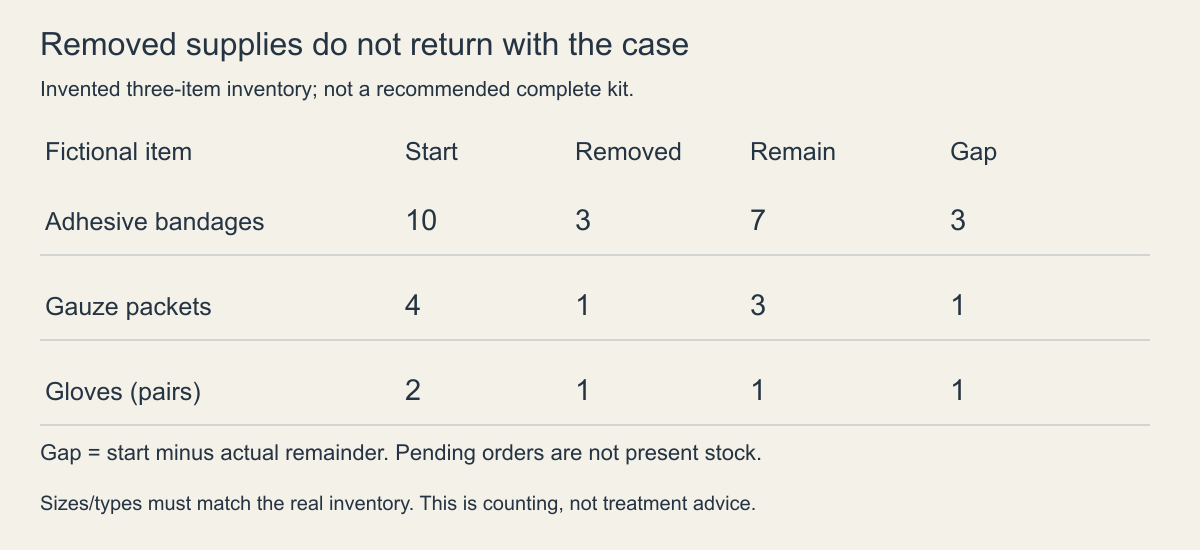
For the fictional cupboard case here, use a deliberately limited three-line inventory: ten adhesive bandages of the same recorded size, four individually packed gauze pads of the same recorded size and two pairs of nonlatex gloves. These quantities are an invented counting exercise, not the Red Cross recommended list or a treatment allocation. The rest of a real kit would need its own check.
Keep the original item identification with the count. Four pads is less useful than four of the particular size and type the kit's established list calls for. A larger or differently described product should not be recorded as an identical replacement merely because it fits into the empty compartment.
Subtract actual removals, then count what is there
Suppose three bandages, one gauze packet and one pair of gloves were removed. The expected remainder is seven bandages, three gauze packets and one pair of gloves. The deficits against this fictional starting inventory are three bandages, one gauze packet and one pair of gloves. All glove quantities are pairs; a single loose glove is not one pair.
Now check the actual contents against that expectation. If only six bandages remain, record six and a four-bandage gap rather than forcing the count to agree with the remembered use. A second removal, an earlier counting error or another explanation may exist. The inventory does not need an invented account of which one occurred.
Keep these columns distinct: intended quantity, present quantity, replacement needed and replacement actually received. Ordered three belongs in a separate pending note; it does not raise the present count. This prevents an online order confirmation from being mistaken for supplies already available in the case.
Buy the missing supplies rather than another undifferentiated box
Check the exact item description, package quantity and applicable instructions before purchasing. A multipack may contain assorted sizes, so its headline total may not replace the particular missing size one for one. Count what the chosen pack actually supplies for this inventory rather than assuming that every compartment is restored by buying any kit refill.
The Red Cross also calls for checking expiration dates. Retain relevant dates and instructions with the actual product. This article has not inspected any packet, verified sterility or supplied a rule for repairing damaged packaging. If condition or identification is uncertain, resolve that question using the actual product information and appropriate supplier or professional advice; do not mark it ready on the strength of a photograph.
The scope stays with non-drug consumables. Medicines, individual health needs and treatment decisions are not additions to this arithmetic exercise. The Red Cross notes that personal items and health-care-provider suggestions may belong in a kit; that is not an invitation to choose another person's medicines from this example.
Close the replenishment loop
When replacements arrive, compare the actual products with the intended items and count them into the case. In the original seven/three/one remainder example, adding three matching bandages, one matching gauze packet and one pair of gloves restores ten/four/two. If an item is backordered, leave its line open.
Set the kit back in its agreed location only with an accurate understanding of what remains missing. A dated check note can be brief, and the regular review still matters even when nothing has visibly been used. A tidy case is useful storage; the replenished contents are a separate, checkable result.
Sources & further reading
Published sources for the details and examples discussed in this story.