Opening the whole art box offers plenty of choice, but it also makes choosing the first thing the entire activity. A smaller invitation can be interesting for another reason: two materials give the same imaginary subject different possibilities. The aim is not to prove that fewer supplies improve a child's skills. It is to offer a concrete place to begin while leaving the picture undecided. The examples here are invented and assume materials intended for the particular participants, with appropriate supervision and product directions followed. CPSC's art-and-craft guidance emphasizes selecting suitable labeled materials and direct supervision. Non-toxic labeling does not make unintended use acceptable. This feature does not clear a particular product or activity for every child.
Invite a line and a broad shape
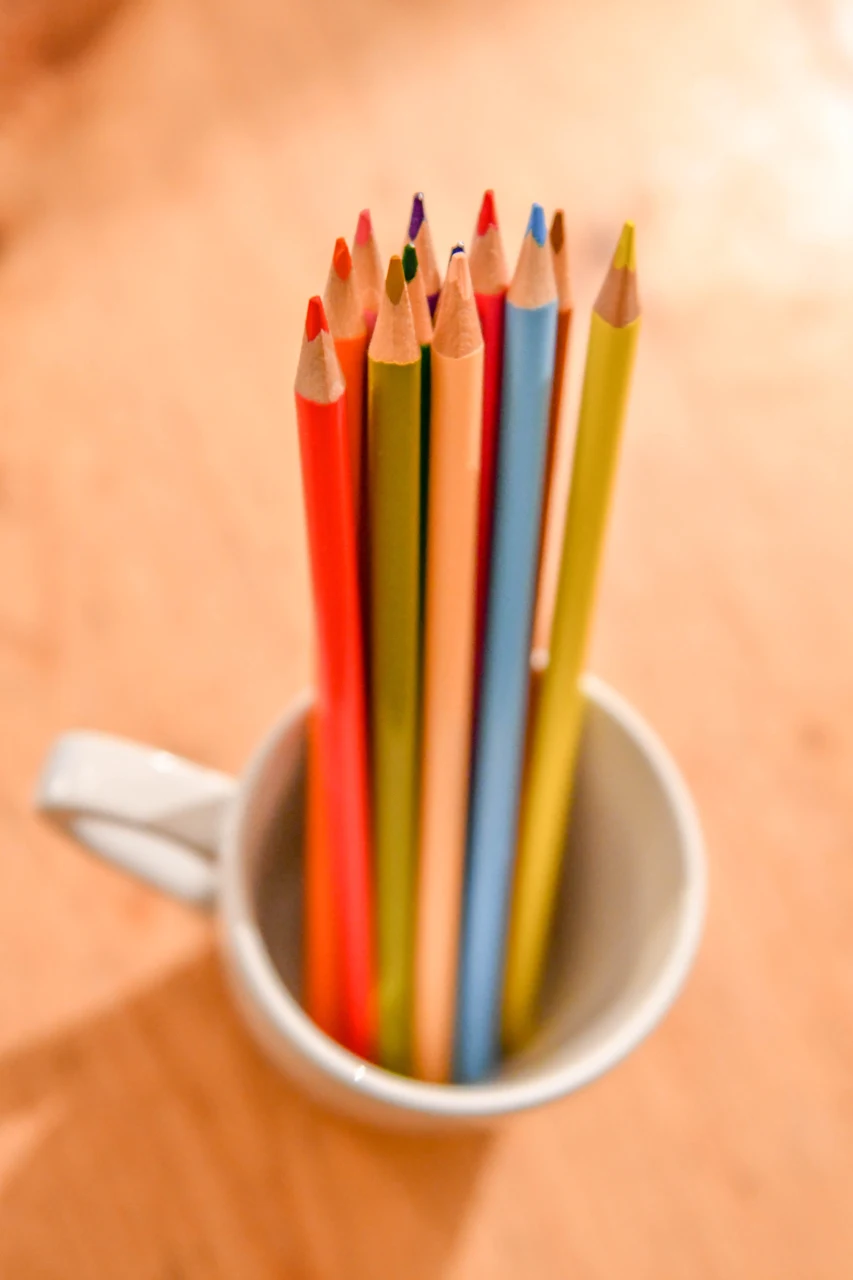
Imagine an adult setting out suitable children's colored pencils and crayons, both in their recognizable packaging, with ordinary drawing paper. They have selected products that the participants can use as intended. There are no loose unlabeled powders, homemade mixtures or adult professional supplies added for effect.
The invitation is, “Would you like to make a place with one long road and somewhere beside it?” A pencil can begin a particular line; a crayon can begin a broader visible patch. Neither tool has to remain in that role. The child can choose the crayon for the road, combine the materials or draw something entirely unrelated.
In one fictional beginning, the road is a winding thin line and the broad blue shape becomes a lake. In another, a broad orange path crosses the sheet and pencil marks become tiny houses. The same invitation has not supplied a model to reproduce. It has named a relationship that each drawing can interpret differently.
Offer two beginnings without ranking them
An adult might say, “I started with a road. You started with that orange area.” That describes the choices without deciding which is more advanced or more realistic. Asking “What belongs beside it?” leaves the next mark with the maker. Asking for a specified tree in a specified corner begins to turn the invitation into instructions for the adult's picture.
Now suppose the child wants only the pencils. Keep that a real option. The second material is available, not a requirement to complete both halves of a task. A child who wants something suitable from the rest of the supplies can ask; the small starting selection need not become a rule against changing direction.
Change the invitation, keep the materials
For a second imagined afternoon, use the same appropriate pencils and crayons but begin with “a very crowded place and an almost empty place.” One drawing might collect many marks along one edge. Another might contain a single large shape and a busy little corner. This is a new starting contrast without buying a new themed kit.
The adult need not fill the empty side or ask the child to make the two parts balance. If the maker decides that the picture is finished, the blank space can stay. If they begin a different story, follow what they actually want to describe rather than rescuing the original invitation.
Keep selection and handling visible
CPSC advises keeping food and drinks out of the art area and supervising to prevent unintended uses. Keep the materials identified, follow their warnings and directions, and choose the activity around the participants rather than expecting a label alone to settle suitability. The original packaging is useful information, not visual clutter that must disappear from a styled photograph.
Before buying a large mixed box, ask which additional kind of mark the participant actually wants to make. Check age information, intended use, warnings and what the pack contains. A replacement for an exhausted favorite may be more useful than several unfamiliar media. Storage capacity or the number of colors does not establish how enjoyable the next drawing will be.
Sources & further reading
Published sources for the details and examples discussed in this story.