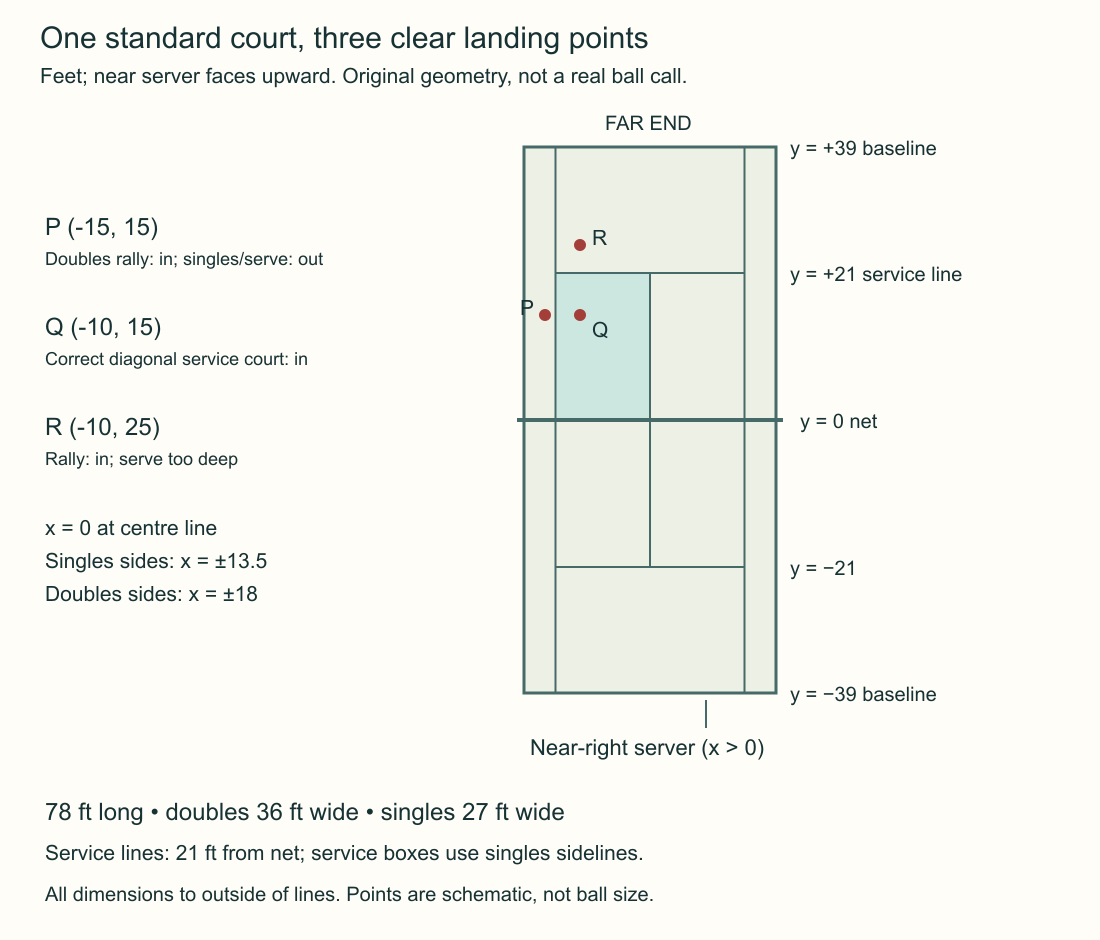
A ball can land within the doubles court and still miss the service court. The apparent contradiction disappears when the question names the phase of play. Doubles uses wider rally boundaries, while a serve must reach the diagonally opposite service court. The comparison below uses the standard court dimensions and service rules printed in USTA's 2026 Friend at Court. Its three landing points are invented and deliberately clear of lines. They are geometry examples, not judgments about a real ball, advice on a serving technique or measurements from a photograph.
Give the court one fixed orientation
Picture a plan viewed from above. The near baseline is at the bottom and the far baseline at the top. The server in this example is behind the near baseline on its right half, facing toward the far end. Right therefore means the right-hand side of this plan for that declared near-end server.
Place the origin at the middle of the net. Horizontal coordinates x increase to the right; y increases away from the near server. The net is y = 0, baselines are y = −39 and +39 feet, and the full length is 78 feet. The doubles sidelines are x = −18 and +18, making a 36-foot width; singles sidelines are x = −13.5 and +13.5, making 27 feet.
The service lines are 21 feet from the net, at y = −21 and +21. They run between the singles sidelines. The centre service line divides each near-net region in half. USTA's Rule 1 states that court measurements are to the outside of the lines. The drawing uses those stated outer boundaries rather than inventing a line-width correction.
P: in a doubles rally, outside the service region
Let P be the clear landing point (−15, 15), in feet. Its far-end position is 15 feet beyond the net; horizontally it is 15 feet left of the centre. That is inside the doubles half-width of 18 feet but beyond the singles half-width of 13.5 feet.
For a doubles rally-boundary comparison, P lies inside the doubles rectangle. For a singles rally-boundary comparison, it lies outside. For service from the declared near-right position, it lies outside the service court because it is in the doubles alley, beyond the singles sideline.
The distinction survives even though P is short of the far service line. Being between the net and a service line is only one requirement. The lateral boundary still matters. Adding a doubles partner does not extend that service box sideways.
Q: inside the diagonally opposite service court
Now use Q = (−10, 15). It remains on the far half, left of the centre line, but its horizontal position is inside the singles sidelines. It is also between the net and the far service line at y = 21.
For the stated server behind the near-right half, that far-left rectangle is diagonally opposite. Q therefore lies within the correct service court in this example. It also lies within both singles and doubles rally rectangles.
Change the server's declared half and you must reconsider which service court is diagonally opposite. “Inside a service box” is not enough when the rule requires a particular one. Keep the server's side in the explanation rather than relying on a label that rotates when someone looks from the other baseline.
R: deep enough for a rally, too deep for this serve
Set R at (−10, 25). Its x coordinate still fits inside the singles sidelines, and its y coordinate remains short of the far baseline at 39. It is inside both rally rectangles.
But R is beyond the service line at 21. It therefore lies outside the service court for the declared serve, even though it remains on the diagonally opposite half. Compare Q and R: their lateral position is identical, so the change in classification comes from depth, not the doubles alley.
These statements classify the specified landing regions only. A complete actual point can involve other rules and events. The drawing does not establish that a real serve avoided the net, that a player served legally or that an observed bounce occurred at these coordinates.
Leave the lines out of the ambiguity exercise
Rule 12 says a ball touching a line is regarded as touching the court bounded by that line. P, Q and R were chosen well away from every relevant line, so none requires estimating whether a real ball touched paint.
When explaining a different example, name the rally or serve question first, keep one fixed near/far orientation, and identify the boundary being tested. The phrase “the court is wider in doubles” answers only part of the problem. The service court keeps its own lateral and depth limits.
The original diagram is a reading aid for these declared coordinates. It is not a copied USTA diagram, a survey of an actual facility or a template for modified junior courts.
Sources & further reading
Published sources for the details and examples discussed in this story.